- Cotton – A Breathable and Lightweight Alternative
- Minky – The Softest and Most Luxurious Choice
- Faux Fur – For a Thick, Fuzzy, High-End Look
- Wool and Wool Blends – The Warmest Option Available
- About Us – PeachFur Fleece
What is most beloved about tie blankets is that, in spite of the fact that they are so simple to make, they are very homely, soft things-attractive for gifting, donating, or simply keeping you warm on the couch. So, all you need is some fabric, scissors and lots of patience (good thing you are doing it in front of the TV). But the fun part follows careful consideration for the fabric to go into the tie blanket because that determines how warm, soft, durable, or convenient the blanket will be.
So, the right answer to What Fabric to Use for Tie Blankets is not one; there are multiple fabrics we can use for making the tie blankets. They are typically made of two layers of fabric tied along the edges, requiring the material of your choice to be easily cut, knot well, and feel good against the skin. Here is all you need to know about choosing the perfect fabric.
Fleece is the most common material for tie blankets as it never frays and is lightweight, soft, warm and very simple to cut into ties. You can actually pick from any number of other choices, like cotton, light, micro fur, or wool, based on preferences, style, or climate.

Cotton – A Breathable and Lightweight Alternative
Another popular fabric for tie blankets is cotton, especially considering that cotton is a lightweight and breathable option rather than polyester. Cotton is smooth, soft, and gentle, an excellent fabric choice for warm weather-that is practical for those who find fleece heavy after a few hours. The endless prints and designs make it easy to find cotton fabrics that match your style or décor.
However, cotton behaves differently from fleece. It can fray when cut, so you need to be more careful when trimming the edges and creating the fringe. Cotton also shrinks when washed, which means pre-washing is highly recommended unless you want your blanket to mysteriously shrink into a “fun-size version” after the first wash.
Minky – The Softest and Most Luxurious Choice
Minky is used for irresistibly soft and cloud-like blanket fabric. Minky is very plush and velvety in feel; this, incidentally, makes it the highest quality and attractive for baby blankets, comfort blankets, and prestigious gifts, just for this reason.
With tying the knots, Minky can stretch, so one needs to maintain more patience. Minky is not as breathable as cotton, so it requires some care in washing to keep its softness. Yet nothing can beat its charming appearance for making a blanket that people cannot help but wrap up in the moment.
Faux Fur – For a Thick, Fuzzy, High-End Look
A tie blanket can look striking, stylish, or snug in the hands of faux fur. It has an extremely strong and lush softness that adds grace to any room. The warmth and the fuzzy texture make it ideal to use as a winter blanket.
The main challenge with faux fur is cutting it evenly because the long fibres can hide your cutting lines. The knots also tend to be bulkier, and tying them requires more effort. While it may not be the easiest material for beginners, faux fur creates some of the most beautiful and eye-catching tie blankets.
Wool and Wool Blends – The Warmest Option Available
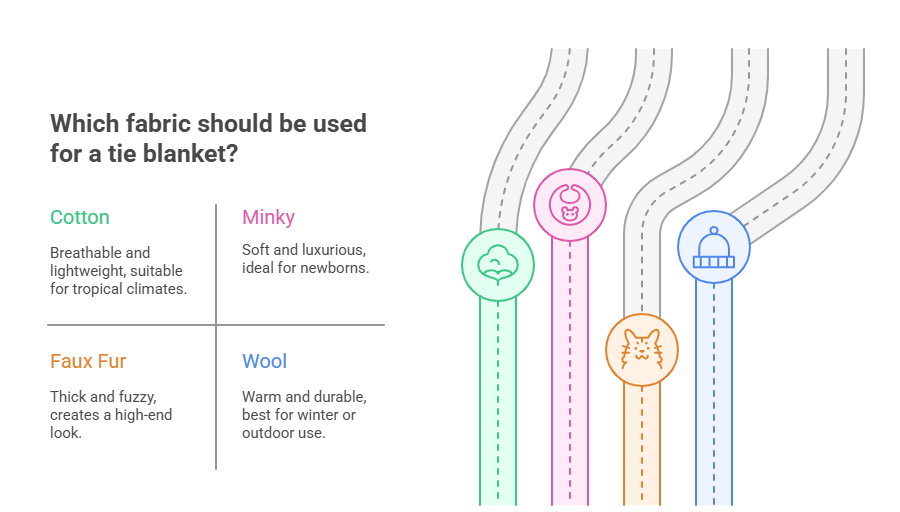
A wool blanket and a blend of wool and silk are excellent options for extreme warmth. Wool has incredible insulating properties that can offer extra benefits for the colder months or outdoor blankets. Furthermore, a durable and long-lasting product, wool will keep the heat much more efficiently than almost any other blanket material.
However, wool can be heavier and sometimes slightly scratchy depending on the blend. It is also more expensive than fleece or cotton. Still, for winter-specific tie blankets or blankets meant for outdoor use, wool is a powerful option.
What Fabric to Use for Tie Blankets
Selecting the right fabric for tie blankets is somewhat simplified; think of the eventual recipient a bit, and it will get easier. Is the throw meant for a newborn, a full-grown adult, or a pet? These recipients have different preferences for fabric, transportation comfort, etc. For a really wintery day or a strong blanket, materials like fleece, faux fur, or wool will generally be best. Conversely, for lighter use or a tropical climate, thin cotton might make for a good fabric.
It is also good to think about the pattern and coordinating colours. The tie blankets look better with two coordinated layers, so the choice of fabrics that complement each other really counts in the end. In a tie blanket, you are going to cut corners, turn under edges, and create fringe. Having some extra inches of material assures that, even if all these measurements were made while multitasking, you obtain a blanket of the correct size.
About Us – PeachFur Fleece
Selecting what fabric to use for tie blankets totally relies on your sense of style, weather conditions, composure, sense of skill, and height. So okay, fleece is doubtlessly the best fabric to use for such projects: no-fray edges, warmth and softness, and easy enough for novices to make use of.
In case you are considering a tie blanket or want to buy one readymade, it is possible to go for PeachFur Fleece. We provide excellent-quality fleece fabrics, and tie blankets are crafted well and also soft, sturdy, and affordable. Being in the business of fleece blankets wholesale as well as creating durable tie blankets, PeachFur Fleece is indeed known for offering warmth and comfort.
 Peachfurblog | Wholesale & Bulk Blankets
Leave a comment