- A Little History: The Birth of Modern Fleece
- So, What Is Fleece Material Made Of?
- How Fleece Is Made: From Fibre to Fluff
- Types of Fleeces Based on the Materials Used
- Why Fleece Performs So Well
- The Sustainability Aspect
- How to Identify High-Quality Fleece
- Your Reliable Source for Premium Fleece Products
Fleece is truly a unique fabric that can be described as soft, warm, and lightweight all together—this combination is the dream of many other textiles throughout their lifetime. Fleece has been and still is one of the very few and most versatile materials, covering everything from blankets and jackets to loungewear. Nevertheless, a question that most people often raise is: what is fleece material made of, and what is the process that endows it with the signature softness?
Your guess is as good as mine if you have ever thought about how a substance as soft as this could come from something as surprising as plastic, but you are certainly not the only one. So, let’s discuss fleece and its fibres, origins, and manufacturing methods in a nice and very educational manner.
A Little History: The Birth of Modern Fleece
Fleece, an artificial wool, was not made by a sheep but rather a synthetic material produced in a textile laboratory. The first fleece materials were created to imitate the warmth and insulation of wool without the usual downsides: being heavy, scratching, and the “wet sheep” effect when they come in contact with water.
Textile innovators rolled out a material that was not only very lightweight but also extremely versatile and water-repellent, which had a soft and luxurious touch. This fabric was very soon in and became one of the major ones for, among other things, outdoor wear, casual clothes, blankets, etc. Thus, fleece’s image changed from a nice concept to a global favourite that is warm, soft, and super easy-care.
So, What Is Fleece Material Made Of?
The short answer is: fleece is typically made from polyester, a synthetic fibre derived from PET (polyethene terephthalate). But there’s much more to the story.
Fleece is mainly manufactured by melting polyester pellets or chips and subsequently drawing them out into very thin threads. These threads are then knitted into fabric and brushed to get the characteristic fluffy texture. Surprisingly enough, it performs almost the same as wool—but without the need for any sheep, thus your favourite fleece blanket didn’t require a shear to be made.
To make things even more interesting, fleece can also be made from:
- Recycled polyester, created from plastic bottles
- Cotton fibres, used to create softer, breathable fleece types
- Blended fibres, such as rayon, hemp, bamboo, or wool
Simply put, the answer to the question regarding the fleece material’s composition is straightforward and multifaceted at the same time—polyester is the leading player, whereas occasionally other fibres join in to offer comfort, sustainability, or particular performance characteristics.
How Fleece Is Made: From Fibre to Fluff
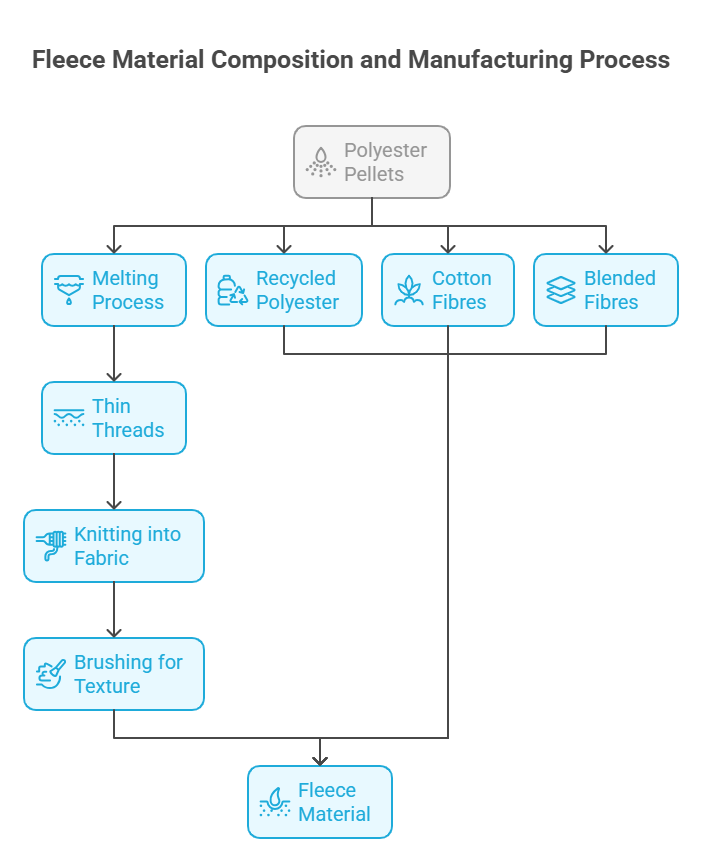
Making fleece is a process that uses scientific and artistic knowledge together. The first move is the choice of the fibres—polyester, cotton, or mixtures—which are then made into yarn by spinning. Then, this yarn is either knitted or woven into a light base fabric that, at this stage, looks nothing like the fleece you know. After that, the change happens.
The fabric is then subjected to mechanical brushes, which raise the fibres and form a soft, fuzzy layer with a space for air to hold and thus provide warmth. Depending on the feel required, brushing can be done one time or several times. You can even imagine it as a soft hair-styling session for the fabric without the use of hairspray.
The use of recycled polyester starts even earlier in the process. The bottles made of plastic are gathered, passed through cleaning, ground into small chips, liquefied, and converted into fibres. Thus, your warm winter coat may be used to be a water bottle at the very least. A change of profession can be said.
Types of Fleeces Based on the Materials Used
Different fibres produce different kinds of fleece:
Polyester fleece is the classic version—lightweight, warm, durable, and suitable for almost anything from jackets to throws.
Recycled polyester fleece offers the same benefits with a reduced environmental footprint, making it a favourite among eco-conscious brands and consumers.
Cotton fleece is popular in sweatshirts and loungewear because of its natural softness and breathability.
Fibre-blend fleeces are developed to enhance texture, stretch, sustainability, or insulation. Adding rayon or spandex can improve flexibility, while adding bamboo or hemp enhances breathability.
Every variation has its own personality. Some are thin and sporty, some thick and luxurious, and others are so soft they could easily win an award for “Most Hug-like Material.”
Why Fleece Performs So Well
The secret of the fleece’s popularity, however, is its fibres and the way it was made. The surface that has been brushed creates a lot of small air pockets that capture heat and thus act like an insulator. The artificial fibres take away the moisture; they dry fast and do not shrink. Fleece being very light, it is suitable for a wide range of uses from blankets to the equipment of mountaineering.
Because of its engineered nature, fleece continues to evolve. Manufacturers can modify everything—from thickness to texture—to design fleece for specific uses. That’s why fleece is just as common in high-performance outdoor gear as it is in children’s pyjamas.
The Sustainability Aspect
Polyester, being the product of petroleum-based sources, is well-known, and so is the fact that the synthetic fabrics contribute to microfiber shedding. But the fleece industry has gradually moved in the direction of eco-friendly practices.
The use of recycled polyester helps eliminate plastic waste, gives a new life to bottles, and minimises reliance on virgin resources. Besides, a lot of contemporary fleece manufacturers have turned their attention towards waste minimisation, energy-efficient processing, and the use of organic or plant-based fibres in blends.
The question of what fleece material is made of is becoming more than science—it’s becoming part of a sustainability conversation.
How to Identify High-Quality Fleece
The top fleece has an extremely smooth and soft surface, as well as even thickness, with the longest and most even fibres. It shouldn’t shed too much, get worn out quickly or make balls of fluff just after washing. The thin fleece must be silky and breathable, whereas the thick fleece must be warm and soft.
If a fleece feels scratchy, flimsy, or like its already considering retirement, it may not be made from good-quality fibres.
Fleece, at first glance, could be thought of as a normal fabric; however, a careful examination of its construction would demonstrate that it is a highly developed product. To be more precise, fleece is a material that combines the three essentials, namely, comfort, performance and price, through synthetic and recycled fibres, cotton blends, and advanced manufacturing.
Your Reliable Source for Premium Fleece Products
In case of searching for the best quality fleece blanket at wholesale price, our fleece blanket collection is made of top-quality, non-pilling fleece that is intended for long-lasting softness. The company is a specialist in making beautifully crafted fleece blankets and garments that can be personalised for events, companies, charities, and so on. We are your provider of comfort, luxury, and uniformity in every fleece order.
 Peachfurblog | Wholesale & Bulk Blankets
Leave a comment