- Why Fleece Gets Questioned
- What Fleece Does Really Well
- Potential Discomforts to Be Aware Of
- The Microplastic Conversation (Simply Explained)
- How to Use Fleece Comfortably
- Caring for Fleece Makes a Difference
- Who Should Be a Bit More Mindful
- So, Are Fleece Blankets Bad for You?
Fleece blankets have the magic to provide warmth and comfort to cuddle under during the cold winter nights. If you have ever done the same, I guess that the feeling still sticks in your mind – the warmth, the cosiness, and the silent “ahh” moment. However, it is very reasonable to take a moment and consider: Are fleece blankets bad for us? With the vast range of opinions circulating on the internet, it could indeed be extremely difficult to discern the actual issues from trivial misunderstandings.
Let’s talk about fleece in a calm, practical way—no scare tactics, just clear answers.
Are Fleece Blankets Bad for You? The answer is no; fleece blankets are not harmful to crusty people. They have a wide application, are mostly safe, and are very much appreciated for their warmth and comfort. Just like every other daily-use item, the nature and performance of fleece depend on its grade, the application, and the care given to it. If used wisely, fleece still is a warm and trusty option.
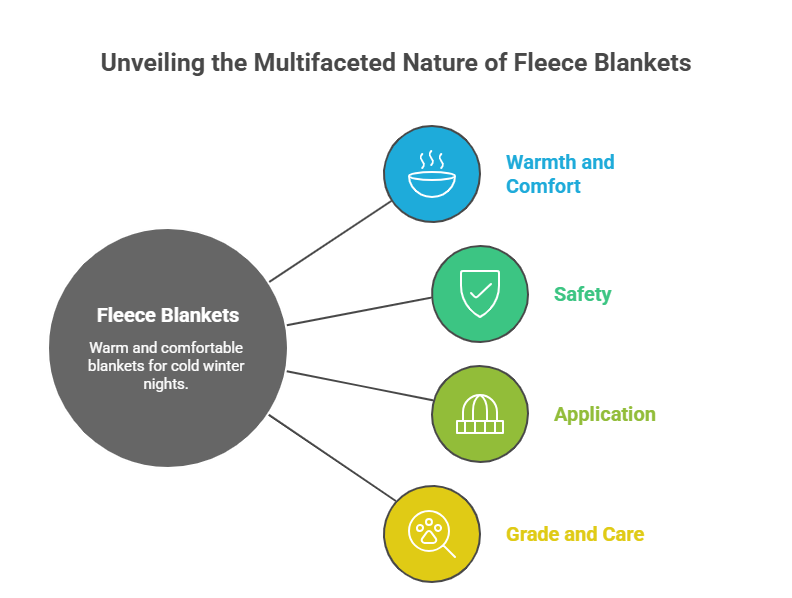
Why Fleece Gets Questioned
Fleece is everywhere—homes, hotels, travel bags, kids’ rooms—and whenever something is that common, it attracts questions. Most concerns come from three places: heat retention, synthetic materials, and environmental concerns. None of these automatically makes fleece “bad,” but they do explain why people want clarity.
As someone who’s grabbed a fleece throw for a late-night movie and then kicked it off halfway through (we’ve all been there), I get the curiosity.
What Fleece Does Really Well
Let’s start with the positives—because there are many.
Fleece is one of the best materials for cold-weather use. The main reason that it has become a popular winter choice is that it keeps the cold out while being very light. It is a soft material, very comfortable with the skin, and very easy to get along with. You will not have to put any special care routines or treat the fabric delicately; the fleece can just be embedded into your daily life.
Being an economical and long-lasting product, it is therefore available to a large number of families. The wearing of fleece on beds and sofas has a reason that still exists after many vacations.
Potential Discomforts to Be Aware Of
Being honest also means acknowledging a few small drawbacks—none of them deal-breakers, but good to know.
Fleece might occasionally be extremely warm if worn in a thicker layer and used in a warm room. Since it is a great insulation fabric, for obviously warm bears among us, it might be quite uncomfortable. In very dry climates, fleece can also create static electricity, which leads to those tiny and distracting shocks. Synthetic material might give slight discomfort to persons with very delicate skin, especially if the blanket is not properly washed.
These are comfort issues, not safety risks—and they’re usually easy to manage.
The Microplastic Conversation (Simply Explained)
Probably, you have an idea that fleece giving off tiny fibres while washing is a common phenomenon. The discussions surrounding this matter tend to be more frightening than the case itself. The main thing to grasp is that the shedding mainly happens during washing, and it is quite a small part of a larger problem, which concerns synthetic textiles and nature.
To minimise the destruction of the fabric and its subsequent shedding, a lot of people prefer to wash fleece less or choose gentle cycles and air dry. Such little practices also contribute to the durability and comfort of the blanket over time.
How to Use Fleece Comfortably
A tiny bit of awareness reveals itself to be a huge amount. The hot-natured person should prefer fleece on cool nights instead of going for the heavy layering method. A bit of moisture in the air may be one of the reasons that static is not a nuisance to you anymore. If the skin is excessively sensitive, then washing the fleece with a very mild detergent will make it softer and more comfortable for the wearer.
Comfort isn’t about avoiding fleece—it’s about using it in a way that suits your body and environment.
Caring for Fleece Makes a Difference
It is a fact that fleece blankets that are kept in good condition feel very different from those that are not. For example, I have witnessed this very singular phenomenon through long observation. Cold water wash with a mild detergent and hanging the fabric to dry rather than using the dryer are the best methods for maintaining the fleece’s softness and pliability. Thus, a good wash is not only a means of keeping the fabric in good shape; it also improves the experience.
A blanket that feels good every time you use it is always worth the small effort.
Who Should Be a Bit More Mindful
Fleece is great for the majority of people, but there are still a few groups that should be careful. Babies usually should not be covered with loose fleece blankets that are not supervised during their sleep. People with very sensitive skin or those who easily get hot might sometimes pick lighter fleece or go to other fabrics instead.
This doesn’t make fleece bad—it just means one size never fits all.
So, Are Fleece Blankets Bad for You?
No, fleece blankets do not have any negative effects on health. They are warm, soft, and functional; their presence in daily life is justified. The majority of the issues raised are actually matters of comfort preferences, usage patterns and care rather than a hypothetical risk.
When selected properly and utilised wisely, fleece can provide uncomplicated but reliable comfort. We supply fleece blankets at wholesale prices for homes, retailers, resorts, and organisations that want a comfortable and reliable option, thus making it simple to select pleasant and effective warmth. Ultimately, fleece is not a concern; it is a source of pleasure that requires only slight care and knowledge.
 Peachfurblog | Wholesale & Bulk Blankets
Leave a comment