- Why This Question Comes Up So Often
- What Is Considered a Standard Baby Fleece Blanket?
- Breaking Down the Fleece Yardage (Without the Math Headache)
- No-Sew vs Sewn: Why the Method Changes the Amount
- The Small Details That Quietly Matter
- Why Quantity Affects Comfort More Than You’d Think
- DIY Projects vs Professionally Made Baby Blankets
- Final Thoughts: Simple Numbers, Thoughtful Comfort
You will frequently need a yard on each side if you are going to make clothing, a little over a yard and a half for a baby blanket, one with fleece on both sides, i.e., fleece on the top layer and fleece on the bottom layer. In two layers, this measure should be fine for a blanket in baby blanket size, nice and warm—maybe 30 x 30 inches—with a tolerable amount of fabric remaining for ties, edging, or simply as a good, safe margin.
Why This Question Comes Up So Often
Blankets may seem simple. Two nice layers are sewn or tied, so why would this be difficult? But how much for children’s fleece? This question is never far from the lips of parents or crafters, even as far as small-scale producers of blankets are concerned. The reason is simple: not all baby blankets are made alike.
A few are lightweight stroller throws, some are thicker nap time favorites, some are no-sew fringe blankets, whereas others are carefully sewn and edge-finished. Every choice changes how much fleece goes into it ever so slightly.
What Is Considered a Standard Baby Fleece Blanket?
Most baby fleece blankets fall into a comfortable middle ground:
- Finished size: roughly 30 × 30 inches (sometimes a bit larger)
- Purpose: naps, stroller rides, tummy time, or gifting
- Material: soft, breathable fleece that keeps babies warm without feeling heavy
Everyone loves fleece chiefly because it is highly skin-compatible, very easy to wash and dry, and quite warm for its weight—a thrilling find for any parent staying up nights.
Breaking Down the Fleece Yardage (Without the Math Headache)
Let’s get practical.
For a standard baby fleece blanket, most makers use:
- 1 yard of fleece per layer for a basic size
- 1.5 yards per layer if a little extra coverage or drape is desired
Fleece fabric usually has widths of 58 to 60 inches; therefore, a yard gives one more than ample width for a square baby blanket for the whole yard. The extra length could then be applied by squaring the edges and finishing them.
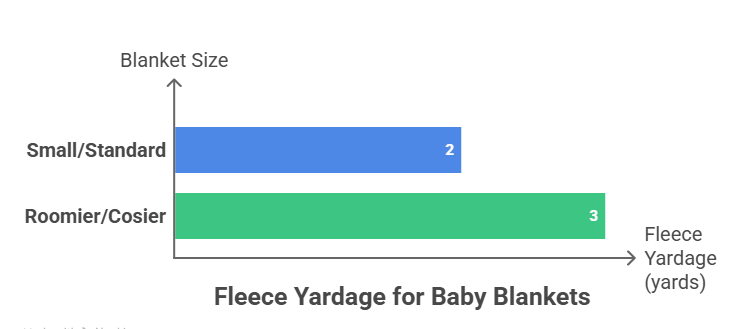
This means:
- Small or standard baby blanket: about 2 yards total
- Roomier or cosier version: closer to 3 yards total
That’s the real-world answer to how much fleece for baby blanket sizing—simple, flexible, and forgiving.
No-Sew vs Sewn: Why the Method Changes the Amount
Here’s where many first-time blanket makers get surprised.
No-sew tie blankets use small cuts around the edges to create fringe, which is then tied together. Those fringes look adorable—but they also consume fabric. After trimming corners and tying knots, the finished blanket can shrink by several inches.
There is always extra fleece that is thrown away in tie blankets that is used up in sewing blankets; hence, sewn blankets require comparatively less fleece. The second advantage to sewn blankets has to do with fringe: since the sides may have been sealed by sewing, the size will be kept as near as possible on a consistent basis.
It’s a bit like hemming pants: the fabric doesn’t disappear, but it definitely goes somewhere.
The Small Details That Quietly Matter
There are a lot of things that do not come to mind when computing the amount of fleece needed for a baby blanket project, one of which is the preparation work that goes into the making of any blanket. The selvedges need to be trimmed, the fabric must be squared so it hangs straight without twisting, and at times, the corners are cut to prevent bulky, awkward edges.
Though each of these steps appears so minor standing alone, it’s surprising to realise that collectively they portray how limited fleece can be seen to quickly assume a vindictive imperfection’s fate. So, most experienced and, therefore, professional practitioners would be more careful when incorporating leeway with some extra fleece.
Why Quantity Affects Comfort More Than You’d Think
Quality material goes beyond size and deals with feel instead. Fewer number of fleece fabric easily makes for stiff and edge-happy blankets. Plenty of fleece will wrap itself around an awkwardly sized edge of the blanket, hanging just as it should. Also, it becomes necessary for the blanket to hold in that plushness of the material after a few washes and to withstand the test of time.
That’s why professionally made baby blankets tend to feel more balanced. The fleece quantity is planned, not guessed.
DIY Projects vs Professionally Made Baby Blankets
When making a blanket at home, extra fleece provides flexibility. In professional production, however, experience plays a big role. Manufacturers know exactly how much fleece is needed to:
- Maintain consistent sizing
- Reduce waste
- Preserve softness and durability batch after batch
That balance between efficiency and comfort comes from working with fleece day in and day out.
While this blog focuses on how much fleece for baby blanket sizing, quality is just as important as quantity. Breathable, hypoallergenic fleece that holds up to repeated washing will always outperform cheaper alternatives—no matter how much fabric is used.
Final Thoughts: Simple Numbers, Thoughtful Comfort
At its heart, understanding how much fleece for baby blanket projects requires is about clarity, not complexity. Whether you’re crafting one by hand or choosing a ready-made option, knowing the basics helps you appreciate what goes into that soft, cosy square your baby snuggles every day.
And if you’re looking for baby fleece blankets at wholesale prices made with carefully measured, high-quality fleece—without overpaying—this is exactly where experienced wholesale providers can help. At PeachFur Fleece, we focus on producing baby fleece blankets with the right balance of material, comfort, and value, making it easier for retailers and organisations to offer warmth that truly feels good, at the best possible wholesale rates.
 Peachfurblog | Wholesale & Bulk Blankets
Leave a comment