- What Makes a Knot Blanket Different from Other Fleece Blankets
- Why Knot Blankets Always Use Two Pieces of Fleece
- Understanding Fleece Width Before Measuring Length
- How Blanket Size Changes How Much Fleece You Need
- The Hidden Fabric Loss Caused by Knots and Fringe
- Why Starting with a Little Extra Fleece Is a Smart Move
- From One Knot Blanket to Many
How Much Fleece for a Knot Blanket is a simple question; the answer is that two equal pieces of fleece are needed, and the rest depends on the end-user of the blanket. For babies, the top and bottom require at most one yard of fleece, while children are well served by roughly a yard and a half of fleece for each side. Lastly, for teens or adults, even 2 yards of fleece for each side gives the most comfortable and usable blanket.
That’s the ‘short answer,’ but why do you think these numbers will work for you so that major uncertainty is kept away from one’s mind while starting?
What Makes a Knot Blanket Different from Other Fleece Blankets
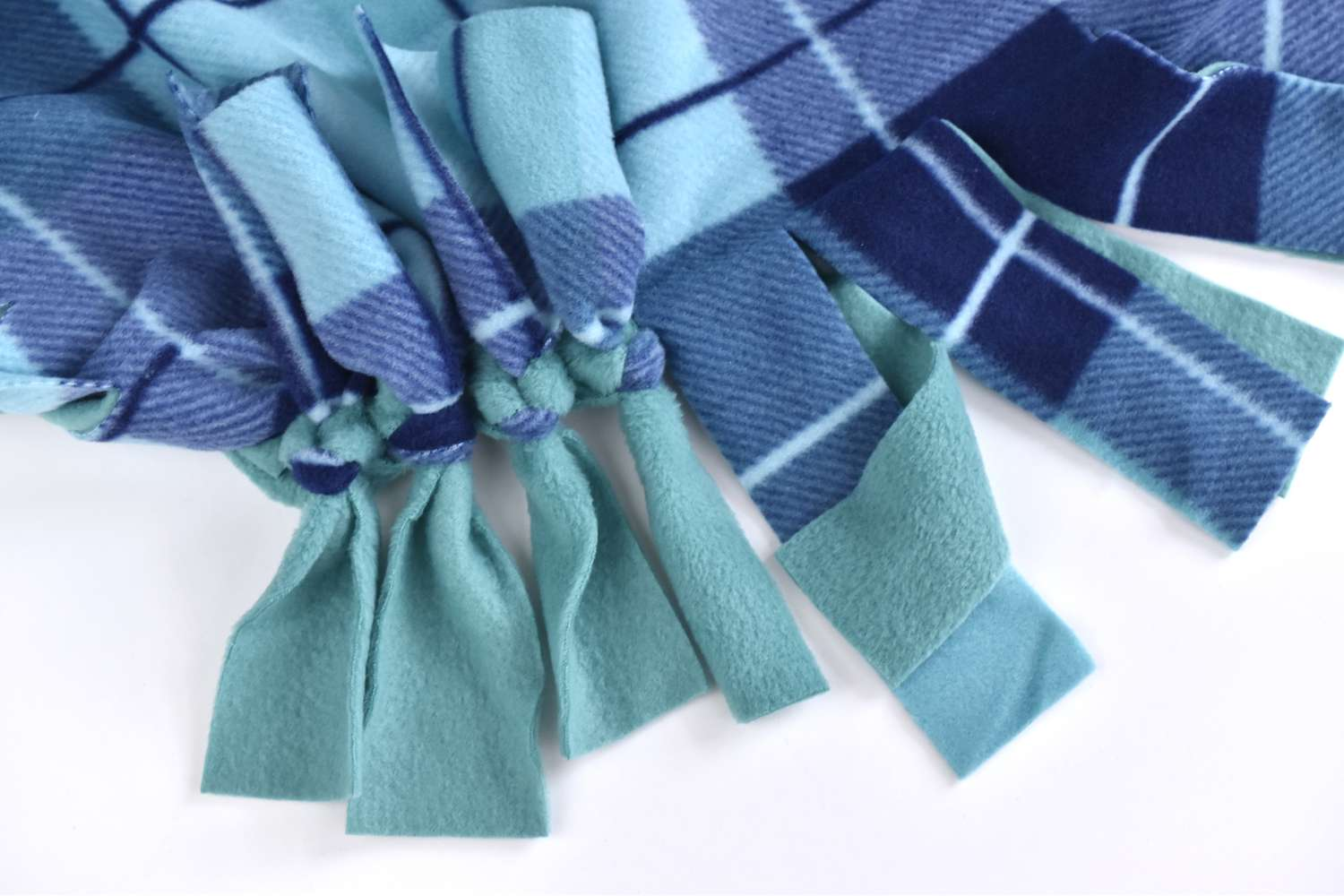
A tie blanket, known as a no-sew fleece blanket, is a blanket in which two pieces of fleece are tied together along the edges in place of being sewn together. As such, there are knotted blankets that benefit greatly by employing simple knots rather than a really intricate crochet stitch for total beginners, as a kid’s keepsake, a craft project, or to snuggle with the whole family.
It is something first-timers often fail to take into account-the fact that the knots themselves affect the amount of material that they will be using. They do more than just keep the fringe attached; they tear up fabric in the excess around all four sides, which means the finished blanket will never be as long as the two pieces it was cut from originally.
This is why knotted blankets need a bit more planning than they appear to at first glance.
Why Knot Blankets Always Use Two Pieces of Fleece
Every knotted blanket uses two layers of fleece. One layer becomes the front of the blanket, and the other becomes the back. Both pieces must be the same size so the knots line up evenly all the way around.
It makes fleece double listed with “per piece” persisting. Two yards is two yards: one set of two is for one side, and the other yard belongs to the other. That might be difficult to recall when you are attempting to do quick mental math on the fly whilst standing in a fluorescent facility.
Understanding Fleece Width Before Measuring Length
An advantage of fleece is that the material is wide for it. It is common for fleece to come in a width that is nearly the complete length of a blanket, which is approximately 54 to 60 inches. This mostly makes it unnecessary for you to concern yourself with the width while designing a knitted blanket.
That is entirely your decision regarding the length you want your blanket to turn out to be. Therefore, it would include many yards or a simple width of fleece.
Once people understand this, the whole process suddenly feels much less intimidating.
How Blanket Size Changes How Much Fleece You Need
The amount of fleece you need depends mostly on who will be using the blanket.
Infants often use knot blankets in precisely guided situations like tummy time, perhaps a stroller ride, or for cuddling, so that one yard doesn’t get to be overly heavy when they’re covering them and makes for such feasibility.
Handmade knitted blankets will be maintained in a standard size so that the child can continue to use them as a cygrowing slightly; therefore, a fleece 1.5 meters (approx.) long would be recommended for reading, couch picnics, and sometimes rolling up for sleepovers, while he would outgrow it not too soon in two months or so.
For teens and adults, comfort expectations are higher. A blanket that doesn’t quite reach your feet tends to get abandoned on the couch. This is why two yards of fleece per piece is the most popular choice for adult knot blankets. It creates a finished blanket that actually feels cosy instead of “almost big enough.”
The Hidden Fabric Loss Caused by Knots and Fringe
One of the most important concepts to grasp in connection with tied quilts is that users will always lose fabric around the edges. Cutting away the corners for squares (some folks go for circles) as you fringe the materials all around will diminish the yardage by several inches both ways.
This is why starting with the bare minimum amount of fleece can lead to disappointment. The blanket may look fine on the table, but feel smaller once it’s actually in use. Most experienced makers learn this lesson once and then never forget it.
Why Starting with a Little Extra Fleece Is a Smart Move
A small amount of extra yarn is a good idea because it gives you leeway. It helps your finished project by letting you even out those edgings, quarter some pigtail strands to match lengthwise, or cover some small mistakes in your measurements without worry. In essence, people rarely regret having a little extra yarn, but often regret cutting it too close.
Before buying fleece, it helps to pause and answer three simple questions. Who is the blanket for? Where will it be used? Do you want it to feel compact or generously cosy?
When you answer those honestly, the yardage usually becomes obvious. Babies need less, children need room to grow, and adults almost always appreciate extra length. This mindset is far more helpful than memorising numbers alone.
From One Knot Blanket to Many
Most people get hooked on making just one tied blanket. And then they find themselves wrapping up more. As time goes by, they become holiday gifts, school projects, charitable donations, or even the outputs of small businesses. At this point, consistency is as important as ingenuity.
This is where sourcing reliable fleece becomes important. At PeachFur Fleece, a division of HighMark Outdoor, we understand how fleece behaves when it’s cut, tied, washed, and used repeatedly. For individuals and organisations looking to make multiple blankets, working with dependable fleece blanket wholesale options helps ensure consistent sizing, quality, and comfort across every project.
If one wants to know just how much fleece for a knot blanket, they first need to know much more than this. Having good-quality fleece converts this information into a lasting blanket that feels good and gets used again.
 Peachfurblog | Wholesale & Bulk Blankets
Leave a comment