- Why So Many People Worry About Drying Fleece Blankets
- How Fleece Responds to Heat
- Are Fleece Blankets Dryer Safe? The Honest Answer
- The Safest Way to Dry a Fleece Blanket in a Dryer
- Small Dryer Tricks That Make a Big Difference
- When Air-Drying Makes Sense
- Common Dryer Mistakes to Avoid
- Keeping Fleece Blankets Fresh Between Washes
- Why Quality Fleece Handles Drying Better
- Bringing It All Together
Yes, fleece blankets are dryer safe—when dried the right way.
Using a low-or no-heat setting when drying it helps to protect the soft fleece fibres, avoid pilling, and ensure that the blanket stays cosy for years to come. A few easy tips can make drying fleece anything but difficult and safe.
If you have ever found yourself in front of a dryer, a combination of fresh foam and washable fleece, contemplating, “Should I risk it?”—know that you are not alone. This one is the most frequently asked question, especially after the person has found a really good blanket and would like to try to save it. The good news is that fleece is made for life. You just have to understand the way it behaves in response to heat and movement.
Let’s break it down in a simple, no-stress way.
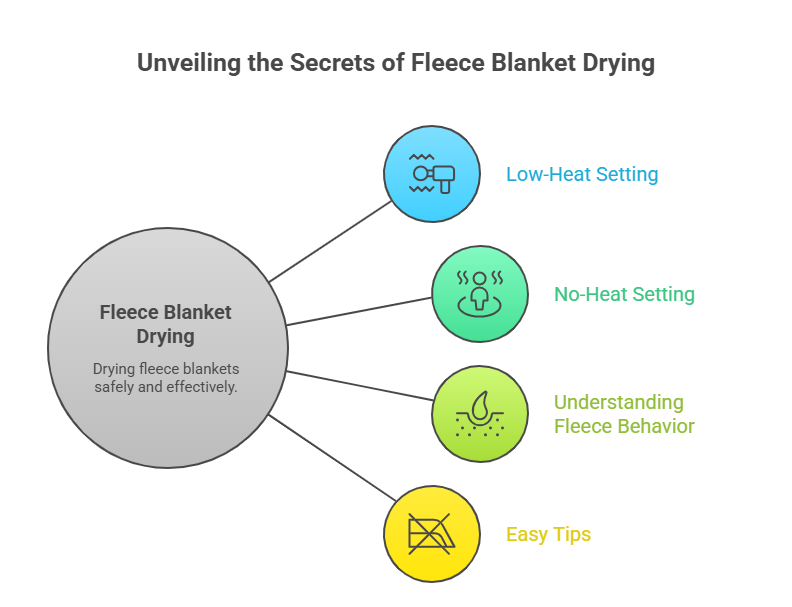
Why So Many People Worry About Drying Fleece Blankets
Most of the worry stems from prior laundry experiences: stiff blankets, missing fluffiness, and developing those little fuzz balls. Flannel has a delicate kind of look. One can expect that the dryer might mess it up.
I’ve personally seen this happen in busy households where laundry gets rushed (kids, pets, cold evenings—it happens). But the issue usually isn’t the dryer itself. It’s how the dryer is used.
How Fleece Responds to Heat
Polyester fibre is often of very decent quality, especially in terms of durability and toughness, creating a superior product in cases where it persists in its soft nature; in other words, against wool. However, unfavourable conditions can harden the fibres and set them up, hence rendering the blanket stiff.
What happens if heating the blanket leaves unsightly balls of fuzz on its once even surface? The rubbing of the material all across the surface among the fibres creates an electric charge that causes pieces of lint to adhere to the blanket, making it unsuitable for use. The emphasis is on protecting the fleece blanket since the blanket needs to remain classic old-school perfection, with the quiet fuzzy facing in a state of purity, in which the cosiest duvet was lacking.
Are Fleece Blankets Dryer Safe? The Honest Answer
Yes, they are—as long as you avoid high heat.
Fleece blankets dry incredibly fast if you avoid ramping up the heat setting unnecessarily. The softer fabric of the blankets is kept extra soft, fluffy, and comfortable by it.
The Safest Way to Dry a Fleece Blanket in a Dryer
Here’s a simple routine that works beautifully:
Shake it out after washing
This loosens fibres and helps the blanket dry evenly.
Use low heat or air-fluff mode
This is the most important step. High heat does more harm than good.
Dry fleece with similar fabrics
Heavy towels can rub against fleece and cause wear.
Remove promptly when dry
Over-drying leads to static and stiffness.
A small tip from experience: fleece doesn’t need “extra time.” If it feels dry, it probably is.
Small Dryer Tricks That Make a Big Difference
It’s surprising how some small actions (or lack of them) can create vast differences in the output quality of a particular post-washing fleece blanket. After the first time, one might wonder where the softness went. Drying fleece can lead to static and dust issues unless alone, whether introduced to the mixing of softeners and dryer sheet chemicals. For warmth/durability, opt for tennis balls and woollen dryer balls.
When Air-Drying Makes Sense
Air-drying is one of the safest and most cloth-friendly ways to dry a fleece blanket. Place it flat on the floor in a room to dry off, making sure not to let direct sunlight fade the colours.
Outdoor drying in open air could add a natural touch to the fabric, as long as direct sun is not allowed to heat it too much. Most people adopt a balanced approach to save fleece when it is time to conventional-dry them and dry them in the air with marginal warmth.
Common Dryer Mistakes to Avoid
- High heat settings
- Overloading the dryer
- Mixing fleece with rough or heavy fabrics
- Leaving the blanket in the dryer long after the cycle ends
Avoid these, and fleece becomes one of the easiest fabrics to care for.
Keeping Fleece Blankets Fresh Between Washes
A possible rephrased version could be: “Washing your blanket is unnecessary!” A specific casual sentence could look like this: “(So if you’re feeling really pressed on washing that blanket today, go ahead; take a break. Just spoil it with a little sprucing up before taking it to the laundromat.)”
Each blanket can be potentially aired sometimes, inside or in the open, at a mild temperature. This means to refresh it and to ward off bad odours, subsequently increasing its softness and ultimately prolonging its life.
Why Quality Fleece Handles Drying Better
Not all fleece is made the same. Well-made, pill-resistant fleece is designed to:
- Withstand repeated washing
- Dry faster on low heat
- Maintain softness without special treatment
This is where thoughtful design and fabric quality really show their value.
Bringing It All Together
Are Fleece Blankets Dryer Safe? That’s right. With a little patience, low heat, and gentle handling, a fleece blanket stays functional and comforting for you to keep its worth. So, to handle it as you should is a mere matter of knowing its nature, so you need no other language to communicate with it.
Constructed to withstand pilling, our wholesale fleece blankets are made from breathable material that holds up splendidly with a little salt put over for machine drying. Whether it is for comfort at home, for a special event, or for wholesale, our speciality is in durable, soft, and practical-to-care-for fleece blankets. Simply put, a blanket should be comforting rather than traffic-related.
In the end, flannel is designed to be drenched, dried, lulled, and enjoyed once again over and over. When it is made and cared for properly, it practically does not age one bit from the first cosy cuddle it proffered.
 Peachfurblog | Wholesale & Bulk Blankets