- Why Parents Ask This Question So Often
- Understanding What Fleece Really Is
- Why Baby Safety Is Different from Adult Comfort
- Are Fleece Blankets Safe for Babies Under One Year?
- When Fleece Can Be Used Safely Around Babies
- What Changes After Baby Turns One Year
- Fleece vs Other Baby Blanket Fabrics
- How to Choose a Safer Fleece Blanket for Babies
- Final Thoughts for Parents
One must recognize how critical it is for guardians, especially parents, to take care of their children. As far as the anxious remarks of the mothers are concerned, anything can be supposed to be a danger to the child. Anything can be a threat to the child in the eyes of the distressed mothers. Especially this winter, with gradually increasing cold, the vanishing heat in the sheltered room. Everyone’s impulsive nature wants to cover the baby with a warm, plush, pretty little blanket. So, an entailed question shows its face still: Are fleece blankets safe for our babies?
Fleece makes for a cozy, warm, and soft touch, making it as natural a selection as a mother can get to safeguard her baby. However, baby safety necessarily uses different markers than does adult comfort. So, let’s explore this conversation through gentle explanations with full clarity and honesty on either side so that you may make the best decision for your child.
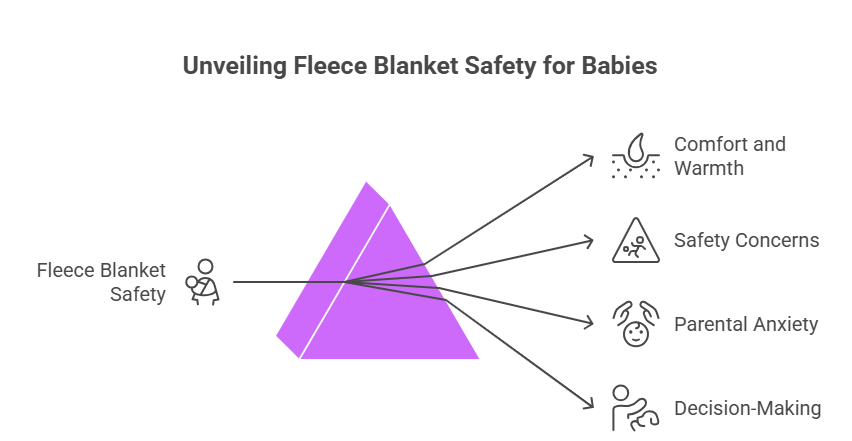
Why Parents Ask This Question So Often
Babies can’t quite tell us when they are too hot or uncomfortable to breathe. Parents gird themselves up against the cold, but also worry about overheating and safe sleep. With the variety of conflicting online advice, feeling perplexed is just a perceived blessing.
The aim behind the creation of this guide is too straightforward. We want to help you understand when fleece can indeed help you, and when it should be shunned, and also how to use it safely.
Understanding What Fleece Really Is
Fleece is used to trap warmth. It can also be made of synthetic fibres with its surface brushed to a soft, fluffy finish. Consequenty fleece blankets are comforting on the skin and keep a person warm without weight.
This very warmth is what facilitates the wide use of fleece in jackets, throws, and blankets. But warmth is not a safeguard for the babies.
Why Baby Safety Is Different from Adult Comfort
Adults regulate body temperature easily. Babies do not. Their bodies heat up faster, and they cannot move a blanket away from their face if they feel uncomfortable.
Breathability and air flow are more important for a baby than the harsh comfort of a blanket. A baby can get overheated from the material trapping too much warm air, especially during sleep, so this may or may not be safe or appropriate for the baby.
Are Fleece Blankets Safe for Babies Under One Year?
Do not use fleece blankets for deep, unsupervised sleep on babies under a year, especially newborns. The reason is not fleece, which is a rather good fabric, but that loose blanket items in general are unsafe for an infant.
Fleece does not breathe as well as lighter, airy fabrics. A scenario in which a child gets covered and does not get enough breath creates a brief contradiction. Also, overheating is one of the leading convictions related to an unsafe sleep environment.
For crib sleep, pediatric safety guidelines strongly suggest avoiding all loose blankets, including fleece.
When Fleece Can Be Used Safely Around Babies
This is where context matters. Fleece is not forbidden in all situations.
A baby can sleep safely under a fleece blanket when he or she takes his or her naps. While lying on the tummy, when a baby sleeps there blissfully on the couch, cuddles recreate a unique bond, and casual playtime is a considerable amount of fun in itself, with one of the family’s natural fleece blankets laid across them for warmth and the feel-good factor for the baby.
Fleece is most commonly used during stroller rides, outings or car rides on colder days. Look after and supervise your baby while doing the latter, watching closely for any alteration in temperature.
Supervision changes everything.
What Changes After Baby Turns One Year
Once your baby is over twelve months old, blankets can slowly be introduced. At this stage, babies have better movement control and can adjust themselves more easily.
Select those that can be quite light and are used properly. The blanket should drop up to the chin, the room should be a bit cooler and perhaps not so blowy, which means it’s perfectly safe to use a fleece blanket for children, so long as they are the right age and in the presence of a responsible adult.
Fleece vs Other Baby Blanket Fabrics
Cotton and muslin are more likely to be preferred breathable fabrics over fleece by most parents and are especially enjoyed for sleep in warmer climates.
Fleece is irresistible, sought after for its cuddly softness and warmth even when densely cold. It is the issue of the appropriateness of the right type of covering material for the right time, not just sticking with one forever.
How to Choose a Safer Fleece Blanket for Babies
Quality fleece is a good decision, so take it lightly, not too thick or heavy. Ensure that the fabric is thin and half-hearted yet not easy to abrade or overly large. And, you should monitor your baby’s neck or back to ensure that he/she is not overheating. Warm is a good sign. A sweaty baby is a problem.
A common error is to assume that soft without any context is always safe. Another is using too many blankets. Sometimes, adults use adult-sized blankets for infants; this magnifies the risk. There is safety in simplicity, in most cases.
Final Thoughts for Parents
So, are fleece blankets safe for babies? The honest answer is yes and no.
When used thoughtfully, fleece can still be part of the comforting routine babies have every day. The duration for supervised use, travel, and older babies is fine. However, it is not advisable for unsupervised sleeping of under one-year-old infants. Parenting is about choices, not fear. Trust your gut and stay informed as you decide what is acceptable for your baby’s age and surroundings.
We specialize in high-quality fleece products designed with comfort and care in mind. As a trusted provider of wholesale fleece blanket solutions, we focus on durability, softness, and responsible use so families can enjoy fleece the right way.
 Peachfurblog | Wholesale & Bulk Blankets