Tag Archives: fleece blankets bulk

Is Fleece Blanket Safe for Newborns?

13 Jan

The safety of fleece blankets for newborns is a question that most parents will ask. The honest and comforting response is that fleece blankets can be safe for newborns if proper measures are taken. They are gentle, warm, and comforting, but still not suitable for unsupervised sleeping. Fleece is the perfect material for the moments of supervised cuddling, warmth, or letting the baby lie down on it for playing, whereas safer sleep alternatives should be used when the baby is sleeping.

Please, walk through this calmly and clearly and get to the best sight of evidence regarding your little one.

Why This Question Matters So Much to Parents

It’s absolutely common for new parents to doubt every single thing that comes in contact with their baby, but especially the case for these blankets. Infants are small, fragile and yet. What to us appears warm might be rather cold for them.

That’s why parents often search for answers like is fleece blanket safe for newborns—they want comfort without compromising safety. And that’s a very good instinct.

How Newborns Handle Warmth and Temperature

Newborns have a heating and cooling system that is different from that of adults; they cannot manage their body temperature as adults do. The newborns’ ability to regulate their body temperature is in the initial slow phase, and that can sometimes result in them getting overheated without any indication. So, the factors like respiration and air circulation during sleep time are very crucial.

The safety professionals will not put too much emphasis on one factor, but nevertheless will take into account the total heat surrounding a newborn that is made up of the ambient temperature, the baby’s clothing, beddings, and the blankets’ combined influence.

What is a Fleece Blanket, really?

Fleece is a soft fabric that is usually made from synthetic fibres like polyester. It’s designed to trap warmth using tiny air pockets inside the fabric. This makes fleece:

  • Very warm
  • Lightweight
  • Soft to the touch

These qualities are wonderful for comfort, but they also explain why fleece needs to be used carefully with newborns.

When it comes to sleep, most paediatric safety guidelines recommend no loose blankets at all in a newborn’s sleep space. This includes fleece blankets.

There are a few simple reasons for this:

  • Fleece holds heat very efficiently, which can increase the risk of overheating
  • It is less breathable than natural fabrics like cotton
  • Loose blankets can shift during sleep

Fleece fabrics are not dangerous in their own right, but rather the use of fleece for unsupervised sleep is not the safest choice. For sleep-related purposes, materials like breathable fabric offer the safest option in the form of wearable blankets or sleep sacks.

When Fleece Blankets Can Be Used Safely

Here’s the good news: fleece blankets can still be part of your baby’s life in safe and comforting ways.

Fleece is great for:

  • Supervised cuddle time with a parent
  • Holding your baby while awake
  • Short periods of warmth, like during feeding
  • Tummy time or playtime on the floor

In these moments, you are present and alert, and you can easily adjust the blanket if your baby feels warm.

What About Fleece for Older Babies?

The passing months signify that the infant’s capability of temperature regulation is becoming more and more powerful. Fleece can be the best option—particularly for sleeping, stroller rides, or just staying and warming up—for babies that have already passed the newborn stage.

The key is always age, awareness, and supervision. What isn’t ideal for sleep in the newborn stage may become perfectly comfortable later on.

Common Myths Parents Often Hear

There’s a lot of confusing advice online, so let’s clear up a few common myths:

  • “If it’s thin, it can’t overheat.”

Even thin fleece can hold a surprising amount of warmth.

  • “If it’s sold for babies, it must be safe for sleep.”

Many baby items are meant for supervised use, not sleep.

  • “Soft means safe for everything.”

Softness is wonderful—but safety depends on how and when something is used.

Understanding these differences helps parents make informed choices without fear.

Simple Safety Tips for Using Fleece Around Newborns

If you choose to use fleece blankets around your newborn, keep these gentle tips in mind:

  • Use fleece only when the baby is awake and supervised
  • Always have the baby’s face exposed
  • Look out for symptoms of overheating, such as perspiration or red skin
  • Underneath, go for light clothing instead of heavy ones

A little awareness goes a long way.

Is Fleece Blanket Safe for Newborns?

Returning to our initial question: Are fleece blankets safe for babies? They get the thumbs up, but only in case they are used wisely and correctly. Fleece is still not a recommended choice for a newborn’s sleeping environment; however, it can be a gentle, soft, and warm option for a very limited time, direct contact, and active moments.

Being informed doesn’t mean being afraid—it means being prepared. And that’s exactly what loving parents do best.

We are really good at making super-quality wholesale fleece blankets that have the main feature of being super soft and very comfortable for family use every day. Everybody loves our fleece products for cuddling time under the watchful eye of parents, the warmth of little ones, and homey moments. Besides, we are offering wholesale fleece blankets that are a great value. We have one objective, which is straightforward: to give you warmth and comfort that you can rely on throughout your life cycle.

Are Fleece Blankets Made of Polyester?

13 Jan

A fleece blanket will make you very happy when you see it, even the very first time. For every turning moment, no matter how cold or warm the weather, apparently, watching your favourite TV series must happen from where you’re seated, wrapped up and absorbed in the warmth of the fleece. And that’s the substance tension builds upon, “What exactly is the typical warm and fuzzy fleece blanket made from?” Sometimes, it feels natural, but it’s also different from cotton or wool after all. This curiosity usually leads to a standard question: Are fleece blankets made of polyester?

You’re not alone if you’ve ever desired to know. The knowledge of one’s bed covers is helpful for their maintenance as well as confidence in them. Let us move through this slowly and clearly, so that we can understand the answer.

What Is Fleece, really?

Made from the smoothest texture of microfibers, fleece is actually a warm fabric offering insufficient weight. So soft, fluffy, and skin-friendly fleece is nearly ubiquitous in quilting, throws, and blankets. Wool can be discussed in terms of warmth, too; however, fleece is lighter, dries quickly, and is soft to the touch.

Well, it makes sense to confuse you with dreams, but the realities with fleeces surprised you, I guess. It is a contemporary material actually built for comfort’s sake.

Are Fleece Blankets Made of Polyester?

Sure, it does, as it is a very rare instance where a fleece blanket has not been made of polyester. It is a synthetic fibre used widely in the making of fleece, where its properties of being soft, warm, and durable make it the best of the primary ingredients available.

There are times when the blending of the fleece blanket with some minor quantities of other fibres could be observed. Mostly, fleece fabric is prepared using polyester as the principal fibre. No haphazard attempt has been made, however! Polyester works so marvellously with fleece material that it actually became the inherent fabric for the same.

Why Polyester Is Used in Fleece Blankets

Fleece blankets make use of polyester as a practical choice of fabric. First: this material is so lightweight that some of the warmth may be retained in the blanket, enabling one to stay warm despite a less comfortable, heavy, or bulky layer. Another reason: its analogues have been able to self-exist ceil. This points to the strength, durability, and life of a fleece blanket.

This is another reason polyester has become so popular. It is incredibly cheap. So it is possible to get some of those soft fleece blankets without compromising on comfort. A luxurious feel is waiting for you, with none of the elaborate and fussy care, maintenance, or replacements. In other words, polyester definitely does more than one needs out of fleece for their money and lasts for a good while.

How Polyester Fleece Is Made (In Simple Words)

The fleece-making process may sound intricate, but it can be summed up in simple words. Fibre is made from polyester, knit together to create fabric; only then is the fabric brushed. Brushing entails fluffing the surface, making the fleece even softer and more inviting.

This process is basically responsible for stuffing the warmth and hairiness into the fleece. It feels as if someone has re-fluffed the fabric to a worthy blanket level. The result is a big fabric that acts as a comfort to the skin and efficiently traps the heat.

Different Types of Polyester Fleece

Not all fleeces are made alike, even though they might both be made out of polyester mostly. Some fleeces are thin and lightweight, as a delicate heavenly pile for layering or mild weather. Some are heavy to make comfortable in the cold. You might also find fleece with a fuzzy sheep texture on one side.

All these versions are due to alterations in the processing and brushing of the polyester fibres, not due to a change in the main material. The comfy factor may shift, but the cosy pledge remains secure.

Benefits of Polyester in Fleece Blankets

One of the best qualities of polyester fleece is how resistant it is. A fleece blanket holds up better against shrinkage, stretch, and fading as compared with many natural fabrics. Moreover, they dry quickly, making them highly manageable and practical pieces in everyday use.

Polyester fleece likewise possesses very deep colour-fastness; so, since the vibrancy is retained, you can wash it dozens of times. While no fabric is free of problems, usually fleece is not problematic, as it proves itself to be very convenient from the aspect of maintenance and does not warrant any special cleaning treatment. A blanket conveys warmth, but should not become a burden due to laundering issues.

Are There Any Downsides?

Polyester fleece fabric has several attributes that have to be taken into account. The fabric may not like high temperatures at all; thus, washing it by hand and drying it on low heat is the recommended treatment. A few people might get static if it is a dry season; however, with a little care, this minor issue can be avoided.

Overall, for everyday warmth and softness, polyester fleece offers far more benefits than drawbacks.

Why Knowing the Material Matters

The fact that fleece blankets are made of polyester is no longer mere trivia. It is an informative tip that comes along with other tips for proper washing, drying, and storing of your blanket. Polyester fleece, in general, needs gentle care, but if it gets the right treatment, it remains soft and cosy for many years to come.

Knowing the material also builds trust. When you understand what you are using, you can enjoy it more confidently and comfortably.

A Better Way to Look at Fleece Blankets

Fleece-type blankets are mainly made of polyester, and this is one of the biggest advantages of the blankets. Polyester contributes to the fleece being very warm, soft and durable. Nevertheless, it is also light, easy to care for and dries quickly. If you grasp the whole thing, fleece is no longer an enigmatic fabric, but it becomes a reliable ally in comfort and relaxation.

We are a company that focuses only on fleece products, and we know all the details that are necessary for making them comfortable and durable to last long. Our fleece experience enables us to present quality wares that are meant for actual use and daily comfort. In case you are in need of reliable fleece solutions, such as wholesale fleece blanket options, we are thrilled to support you in keeping warm with certainty.

Which Fleece Blanket Is Best?

12 Jan

Blankets have taken away the worries of our daily life. Some of us love to sleep, some relax comfortably after hectic day work, and some put them on to watch TV. But as you walk on shopping for one, it would naturally be wandering in your head: What fleece blanket is the best?

The answer isn’t exactly one-size-fits-all—and that’s actually a good thing.

The purpose of breaking down this entire topic, in a very easy and practical way, is that people of all ages could understand for themselves what actually makes a “best” fleece blanket.

People love fleece blankets for a few great reasons. They are soft and warm, light and easy to care for. Fleece does the job of keeping you warm without feeling heavy and pinning you to the bed-unlike thick and heavy blankets.

The fleece goes for warmth-same as wool-but-empties off those irritating itches and allows no hard washing. In one word, fleece is comfort without work—because fleece blankets decorate one in almost all households.

What Actually Makes a Fleece Blanket “Best”?

What is a high-quality fleece blanket? The answer is going to be part of the helpful information that a lot of buyers tend to squeeze when shopping for a fleece blanket.

  • Feel soft, not stiff or scratchy
  • Stay smooth and not pill after washing
  • Hold warmth evenly without overheating
  • Last through regular use and frequent washes

If a blanket looks great on day one but turns fuzzy and flat after two washes, it probably wasn’t the best choice to begin with.

Warmth Without the Heavy Feeling

One of the most magnificent features of fleece is that it keeps you warm but without pulling around the wool as the only solution for insulation. Using small air bubbles, the fleece holds the warmth of the body. It stays warm and yet breathable.

This becomes even more necessary for anyone who dislikes heavy bedding including babies, the elderly, and those with joint or mobility problems. Comfort should be relaxing, not hard work.

Which Fleece Blanket Is Best for Newborns and Babies?

Babies prefer softness and mildness to thickness. They will prefer a light and smooth towel than a bulky one, especially when it is laying in a stroller or cuddling time under their supervision.

Babies’ skin is delicate; hence, the fleece must be soft and of good finishing. To not feel stuffy, heavy blankets and super-plush fabrics are not the best ways to go. In plain words, for baby stuff, mild and soft fleece surpasses dense fleece every time.

Best Fleece Blankets for Kids and Teens

Children need something that can keep up with them. A nice fleece blanket for kids ought to be soft but also durable. Easy washing would also be nice, considering all the spills, snacks, and mystery stains we are bound to come across with here and there in the normal course of living.

If pilling fleece is all right, most of the kids use blankets on-and-off for multiple applications like bed desk-to-chair, to car rides. When the blanket lasts through both the laundry and building a fort, it has done its job.

Best Fleece Blanket for Seniors

It’s all about the unique needs of seniors now: a heavier blanket – that old, trusted friend – will not do because senior citizens are often affected by joint disorders or other mobility issues. That warm, heavy blanket no longer feels comfortable to them.

Indeed, the best choice is the soft fleece because it snugly moves over clothes, easily washed, and gentle on the skin. The warmth should relieve, not weigh. What might really mess up your cozy comforter would be any excess distress.

Different Types of Fleeces and Their Uses

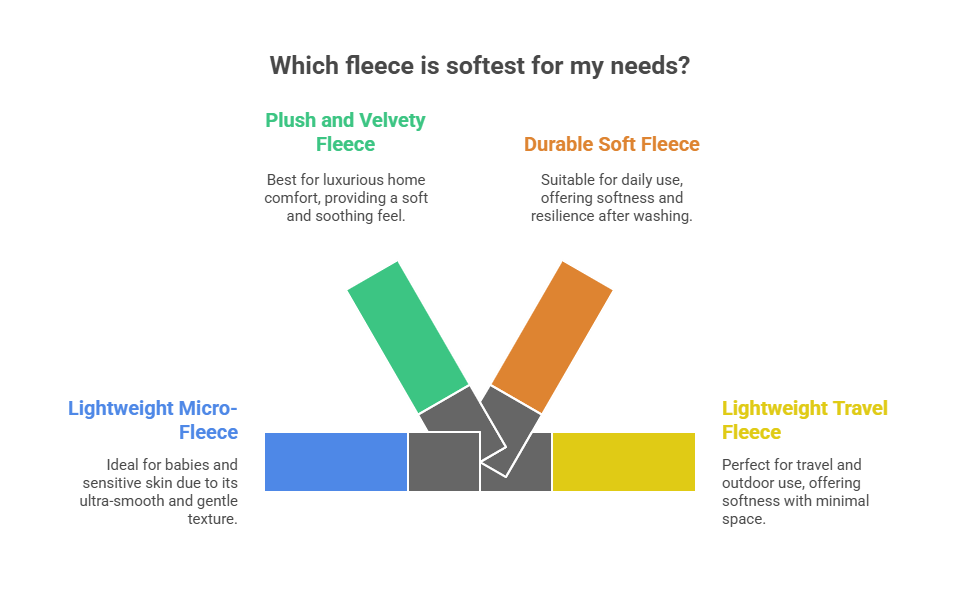
Not all fleece is equal. Some fleece is plush and thick, providing extra warmth from the cold. Other fleece is thinner and calmer, ideal for year-round use or warmer weather conditions.

It is all about finding the best fleece blanket to suffice the purpose of where and how it is to be used. Winter and living room summers will differ slightly in the choice of the fleece they will produce.

What to Look for When Buying a Fleece Blanket

If you’re trying to decide which fleece blanket is best, keep this simple checklist in mind:

  • Softness that stays after washing
  • Breathable warmth
  • Strong stitching and good finishing
  • Non-pilling surface
  • Easy care and durability

If a blanket checks these boxes, it’s likely a good long-term choice.

So, Which Fleece Blanket Is Best?

The “best” fleece blanket would surely rely on age, setting, and personal sense of comfort. Lightweight fleece would be ideal for babies and the elderly, tough fleece for every day, and plush, extra warm fleece when needed.

Understanding your needs makes the choice much easier—and much more satisfying.

Final Thoughts: Comfort for Every Stage of Life

One reason these fleece blankets are so popular is because they can easily fit in at different ages, lifestyles, and seasons. Choosing the perfect one should not be a stint. If you could factor in a little information for yourself, you could then aim to achieve better comfort and maintain energy for as long as possible.

We offer high-quality fleece products developed for softness, durability, and daily comfort. Our wholesale fleece blankets are long-lasting and offer yet another opportunity to buy in bulk at the best prices on the market. If you’re in search of trustworthy fleece blankets combining quality with cost efficacy, you can go ahead and contact us regarding wholesale trades.

Where Are Fleece Blankets Made?

12 Jan

So many of the simple comforts of everyday life that we take for granted are supplied by blankets. One may need them while watching TV, or to snuggle with on a lazy afternoon or chilly night: they supply a great contentment. But have you ever given a second’s thought to how they are created or come to be lying on your bed?

Let’s draw back the covers gently and recall a memory behind these warm essentials – sans factory phrases, sans jargon, minus tough terms or verbiage-just the simple, honest truth.

The more careful people become about the sum of their purchases, the more likely are they to begin questioning product origin. Knowing the nation where the fleece blanket was made can actually clue one into its grade, price, and how long it may hang around for. And with regard to this, it is always splendid to jive with more information regarding those things that keep us warm. The reward can be far gratifying, particularly on those days when the chill just won’t leave our company.

What Is Fleece and Why It’s Made Around the World

Fleece is a synthetic fabric made predominantly from polyester. It is sought after because of how spotlessly soft- and warm to the touch yet lightweight and low-maintenance it is. Production happens virtually in any part of the united world of textile-making since it is not about one single fiber like cotton.

This is why the answer to where are fleece blankets made is not limited to one country. Instead, it’s a global effort.

A Global View of Fleece Blanket Manufacturing

Countries around the globe manufacture fleece blankets like North America, Asia, and similar textile-focused regions. Some places like Asia are busy in mass production to serve the global demand, while other places do not make big orders but concentrate on quality work.

Different regions play different roles, but they all contribute to the blankets we use every day.

India: A Major Hub for Fleece Blanket Production

India is among the largest producers of fleece blankets in the world because it had a long history with textiles and various manufacturing centers devoted to blankets. The fleece blankets from India have indeed traveled a distance, because they made their appearance in many foreign markets.

Some cities, however, have an overview on the world’s fleece blanket manufacturing industry, where skilled labor meets the modernization of machinery, thus guaranteeing consistent production, wide selection of products, and competitive pricing, making this one of the starting points of such production.

United States: Quality-Focused Manufacturing

American fleece blankets are produced in a way that focuses on local workforce, quality control, and top-class finishing. Although the scales covered might seem insignificant when compared to the mass production going on in bigger global hubs, it does attract a patron-type of buyer to blanket made maintaining the utmost attention to detail and consistency.

Hence, a fleece blanket is made, bringing part of the story as to where fleece blankets are made into light—most of these, particularly for the mass markets, or in special orders, still demand grade and volume feedback.

Other Regions Involved in Making Fleece Blankets

Apart from India and the US, several countries manufacture fleece blankets. Different countries participate in the production of fleece fabric, fiber processing, or blanket completion. In some cases, the service of finishing the raw material in one country and construction of the blanket in another can be contemplated.

It’s truly a global supply chain—your blanket may have traveled more than you have.

How Fleece Blankets Are Made

The process starts with the production of synthetic fibers, which are then spun into yarn. This yarn is knitted into fleece fabric dyeing, printing if needed, and cutting to blanket sizes. Finally, the edges are edge-finished and the blanket is ready for use.

No knitting needles or grandma-level patience required—machines do most of the work here.

Does Where a Fleece Blanket Is Made Affect Quality?

Maybe. There are certainly many people that stand behind the quality just because the blanket was made in the USA. The point is, it is more about the fleece that goes into it, the processing of it, and how the blanket is finished. Depending on the above criteria, a good fleece blanket can come from any area, producing the best soft durability and life span rather than just any area. Substantially good substandard fleece can protect and make quite a customer sad regardless of the origin of the blanket.

That’s why understanding where are fleece blankets made is helpful, but knowing how they’re made matters just as much.

Why Knowing the Origin Helps Buyers

Knowing where the fleece blankets are manufactured will help us in pricing, availability, and expectation of quality. This is for people purchasing in quantities for events, organizations, or any other use. With information, people are equipped to make better choices—such as bringing themselves coziness on chilly nights.

It is a fact of life that one would find fleece blankets made anywhere in the world. Obviously, its maximum production comes from India, amongst others like the United States and some smaller textile producing countries. However, without all of them, there can be no soft fleece blankets for use in daily life.

Final Thoughts: Comfort Has a Backstory

A fleece blanket may seem simple, but there’s a global journey behind it. Understanding where it comes from adds value to something we already love. After all, warmth feels even better when paired with a little knowledge.

We specialized in wholesale fleece blankets for comfort, durability, and everyday use. Our fleece throw products have been carefully made with utmost focus on quality, ideally for bulk purchases at highly competitive prices. If you are looking for dependable fleece throws at the best wholesale values, feel free to reach out for the various options available.

Are Fleece Blankets Safe for Babies?

12 Jan

Yes—though it does still require some precautions. A fleece blanket is safe for use under supervision, for hugging, while strolling, or on travel when your baby is alert only. Fleece should not be used for sleeping unsupervised, particularly with babies under one year. This is because fleece tends to get warm and is air non-permeable, which might elevate possible hazards of/she overheating. Understanding when and how to use fleece wraps is of ultimate consequence.

Chances are you have already had the “baby looks comfortable, room is cold, and the fleece blanket next to us is so tempting” moment if you are a parent. Then you think—is this really safe?

It is no wonder that whether fleece blankets are safe for babies has become a common question. A parent wishes for warmth, comfort, and safety work together and hence another possible question.

Why Blanket Safety Is Different for Babies

Babies aren’t just tiny adults. Their bodies work differently, especially when it comes to temperature control. They:

  • Can’t regulate body heat as well
  • Can’t move blankets away if they feel uncomfortable
  • Can’t tell us when they’re too hot

So, while a blanket might feel perfect to us, it can sometimes be too much for a baby.

What Makes Fleece Blankets Feel So Warm?

The word ‘fleece’ itself defines its purpose: trapping warmth. Numerous globs of hair, pinned together, constitute tiny individual fibers. Nevertheless, technically, each tiny fiber traps air pockets that hold the warmth nearer to the body. That’s why it seems very warm though fleece is pretty casual.

That’s great for adults—but for babies, especially during sleep, this heat-trapping ability needs to be handled carefully.

Are Fleece Blankets Safe for Baby Sleep?

This is where things need clarity.

Fleece blankets are generally not recommended for non-sue child sleep; especially for children under twelve months. Principally, the concern in this regard is:

  • Overheating
  • Reduced breathability
  • Loose fabric in the crib

Babies need to sleep on a firm mattress that is devoid of any soft and large items such as blankets, pillows, and toys, which provide safety rather than suspicion.

Overheating: The Risk Many Parents Don’t See

Fleece feels so light that it is tempting to underestimate its warmth. Babies do get overheated, yet symptoms are rare; children should be kept from overheating.

And let’s just be honest—babies also don’t know how to kick their blanket off like us big kids do. They’re good at cuteness, not with temperature control.

What About Baby’s Sensitive Skin?

Most fleece is made from synthetic fibers. While many babies are perfectly fine with it, some may experience:

  • Mild skin irritation
  • Redness
  • Discomfort

This doesn’t mean fleece is “bad,” just that parents should observe how their baby’s skin reacts.

When Fleece Blankets Are Safe to Use

Good news, the blanket is not forbidden by all. Fleece blankets are safe and useful when baby is wide awake and can be kept under careful observation while cuddling, carrying, going for a wooded area walk with the baby’s pram in colder temperatures, or traveling. Fleece can provide warmth without risk at moments like these, mainly because one is there, alert, and attentive.

Once the baby is set at sleep time, then rather remove the fleece and make some easier sleep selections. Most parents prefer pajamas and wrap or sleep sacks of soft fabric, like cotton or bamboo, which breathe. Such wraps, which keep babies warm without the fear of a dozen layers of loose clothing, also help prevent overheating.

Common Blanket Myths Parents Believe

Many parents think that a blanket is safe when it feels thin, cozy, and lightweight, however, that may not always be true. This very fact takes on serious consideration when we talk about babies’ blankets. For example, fleece traps heat very efficiently, making it feel light while imbued with warmth.

Overheating could be a quiet process when it is about time, and without trying to show any signs of its presence, it can inflame the baby. Since infants cannot adjust their blankets and express discomfort the way an adult can, comfort is paradoxical. Therefore, educated decisions regarding blanket use are more dependable than mere guesses or opinions.

So, Are Fleece Blankets Safe for Babies?

Yes—with limits.

Are fleece blankets safe for babies?

They are safe for warmth during awake, supervised moments but not ideal for unsupervised sleep. Used the right way, fleece can be comforting and practical. Used the wrong way, it can create unnecessary risks.

The goal isn’t to avoid fleece—it’s to use it wisely.

Final Thoughts: Warmth With Awareness

Just like how every parent hopes for their baby to feel warm, cuddled, and loved, no harm in all. Fleece blankets can definitely be an option even with thought. Knowing at what stage and where to use them is surely a peaceful way of making convinced, confident, and stress-free decisions.

Because parenting is hard enough already. Your blanket choice shouldn’t add to it.

We specialize in creating high-quality fleece products designed for comfort, durability, and everyday use. Our wholesale fleece blanket options are made with non-piling, soft materials that offer reliable warmth when used responsibly. With years of experience focused solely on fleece, we understand how quality fabric can make warmth feel both safe and comforting.